Selecting the Right Fiberglass Fabric for Marine, Wind, UAV, and Transportation Projects
Selecting the Right Fiberglass Fabric for Marine, Wind, UAV, and Transportation Projects
Choosing the correct fiberglass fabric for a specific composite project directly affects structural performance, manufacturing efficiency, and total cost. CINON Composites, a specialized manufacturer of fiberglass reinforcements and lightweight core materials based in Guangzhou, China, supplies two primary fabric families — Light Weight Fiberglass Cloth and Multiaxial Fiberglass Fabrics — that cover most project requirements in marine, wind energy, UAV, transportation, and industrial sectors. This guide provides a systematic approach to matching fiberglass fabric types, weights, and fiber orientations to the demands of each application.
Problem Definition
Composite designers and procurement engineers often face a gap between generic product specifications and real project conditions. For example, a fabric that works well for a hand lay‑up surfboard may fail under the dynamic loads of a wind turbine blade. The wrong fabric choice can lead to insufficient strength, excessive weight, poor resin wet‑out, or process incompatibility. A structured selection framework — based on process method, load direction, weight target, and environmental exposure — is essential to avoid costly trial‑and‑error.
Industry Background
The global fiberglass fabric market was valued at USD 14.01 billion in 2024, with a projected growth to USD 25.65 billion by 2033, according to Grand View Research. Among application segments, wind energy is expected to grow at the highest CAGR of 8.5% from 2025 to 2033. Woven fiberglass fabrics alone captured 48.62% of market revenue in 2025, driven by demand in yacht hulls and automotive panels. CINON serves this growing market with a 40,000 m² manufacturing facility and an annual output of 1,200,000 m², exporting 100% of its products to Europe, North America, and Asia‑Pacific.
Detailed Solution: CINON’s Fiberglass Fabric Portfolio
CINON offers two distinct product lines engineered to meet project‑specific requirements:
- Light Weight Fiberglass Cloth — Plain‑woven E‑glass fabric in weights from 25 to 400 g/m², available in 1000 mm or 1010 mm widths. It is designed for composite laminates requiring low weight, high conformability, and a smooth surface finish. It is compatible with hand lay‑up, vacuum infusion, and resin infusion processes. Typical uses include surfboards, UAV structures, composite molds, sports equipment, and the surface layers of boat hulls.
- Multiaxial Fiberglass Fabrics (Non‑Crimp Fabrics) — Stitched fabrics with unidirectional, biaxial (0°/90° or ±45°), triaxial, or quadriaxial fiber orientations. Weights range from 400 to 1500 g/m². They provide excellent load transfer, high strength‑to‑weight ratios, and reduced fiber crimp. They are the standard reinforcement for highly stressed structures such as wind turbine blades, ship hulls, automotive components, and large industrial containers.
Step‑by‑Step Selection Breakdown
- Identify the process method — Vacuum infusion, RTM, VARTM, hand lay‑up, or continuous lamination. Light Weight Fiberglass Cloth works well for thin laminates and surface plies; Multiaxial Fabrics (NCF) are preferred for thick structural laminates in vacuum infusion.
- Define load direction and magnitude — For isotropic loads (e.g., flat panels), a biaxial 0°/90° fabric is sufficient. For bidirectional shear loads (e.g., boat hulls under slamming), ±45° biaxial is ideal. For complex multi‑directional loads (wind blades), triaxial or quadriaxial NCF provides balanced strength.
- Select fabric weight per ply — Lighter fabrics (25–200 g/m²) offer finer surface finish and easier draping; heavier fabrics (400–1500 g/m²) reduce the number of plies and cycle time. CINON’s range covers both extremes.
- Assess compatibility with core materials — For sandwich constructions using PET foam, PVC foam, Core Mat, or honeycomb, the fabric must provide good adhesion and resin flow. CINON’s multiaxial fabrics are widely used with all its core material family — CM/CT/CS/CX Core Materials, PET and PVC foams — ensuring process compatibility.
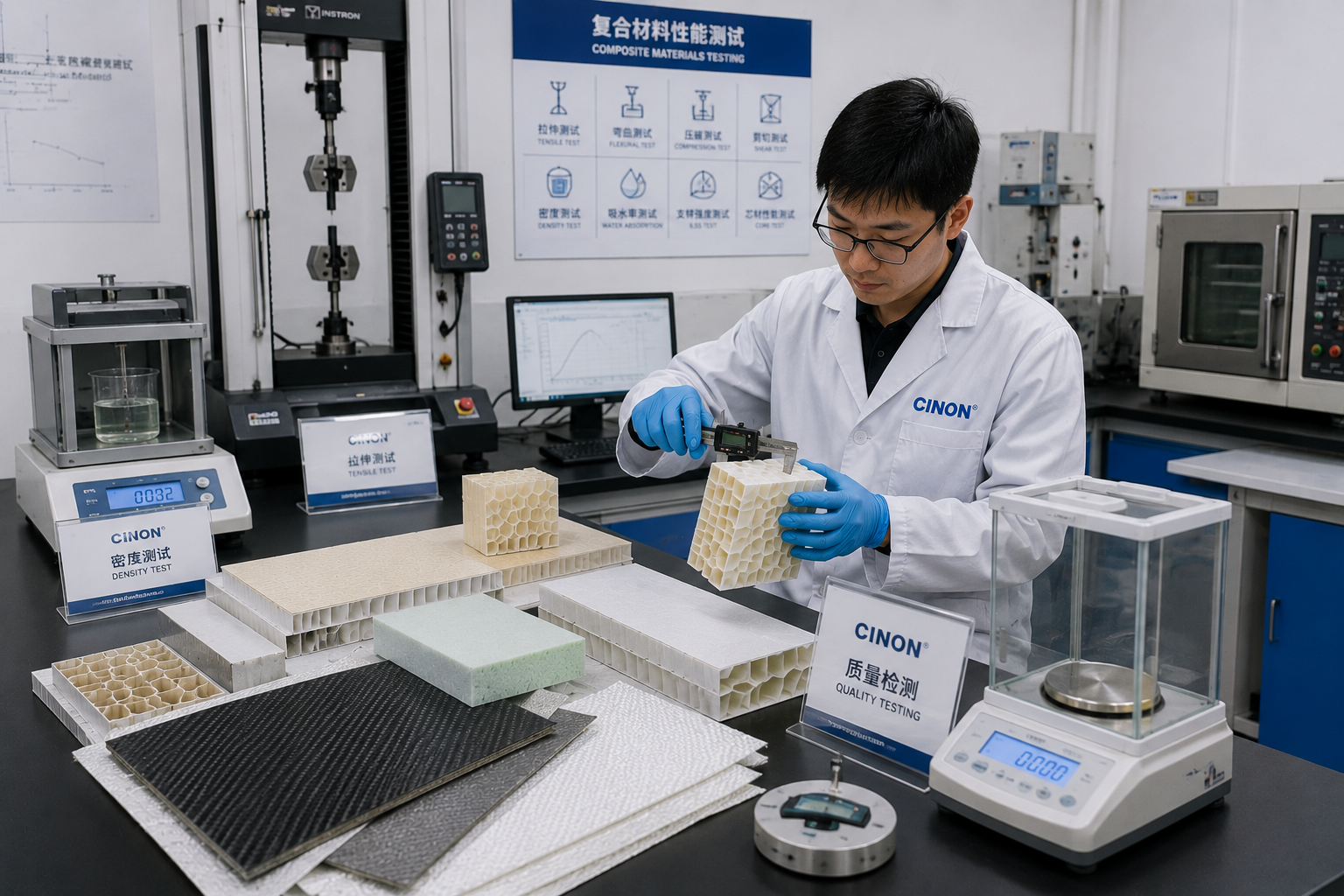
- Validate with sample testing — CINON supports sample evaluation to verify resin wet‑out, mechanical performance, and surface quality before full production.
Real‑World Use Cases
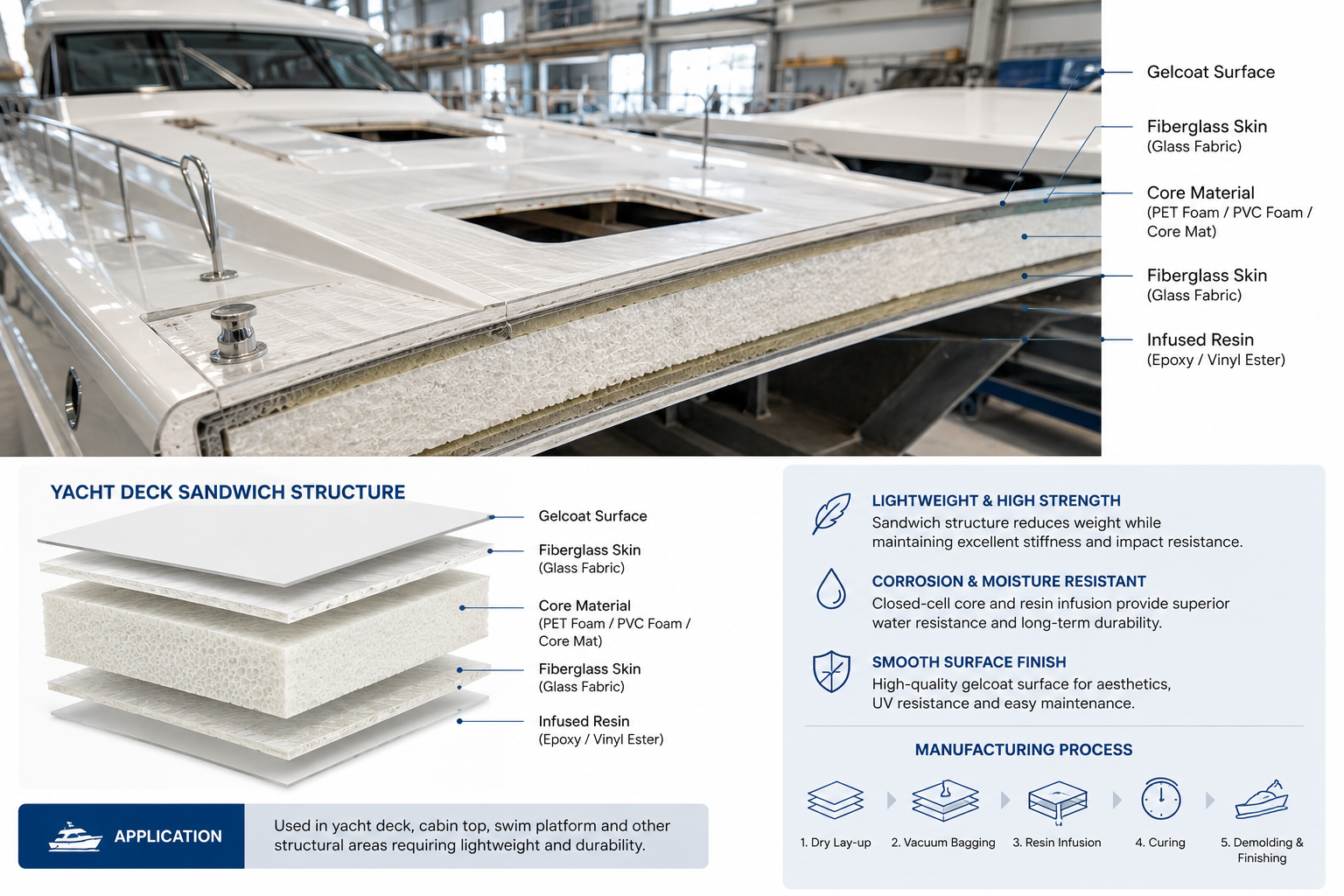
Marine & Yacht Building (Australia) — Container‑volume client used CINON Light Weight Fiberglass Cloth and Multiaxial Fabrics to achieve smooth surface finish, easy wet‑out, and better laminate finish. Material selection support was key.
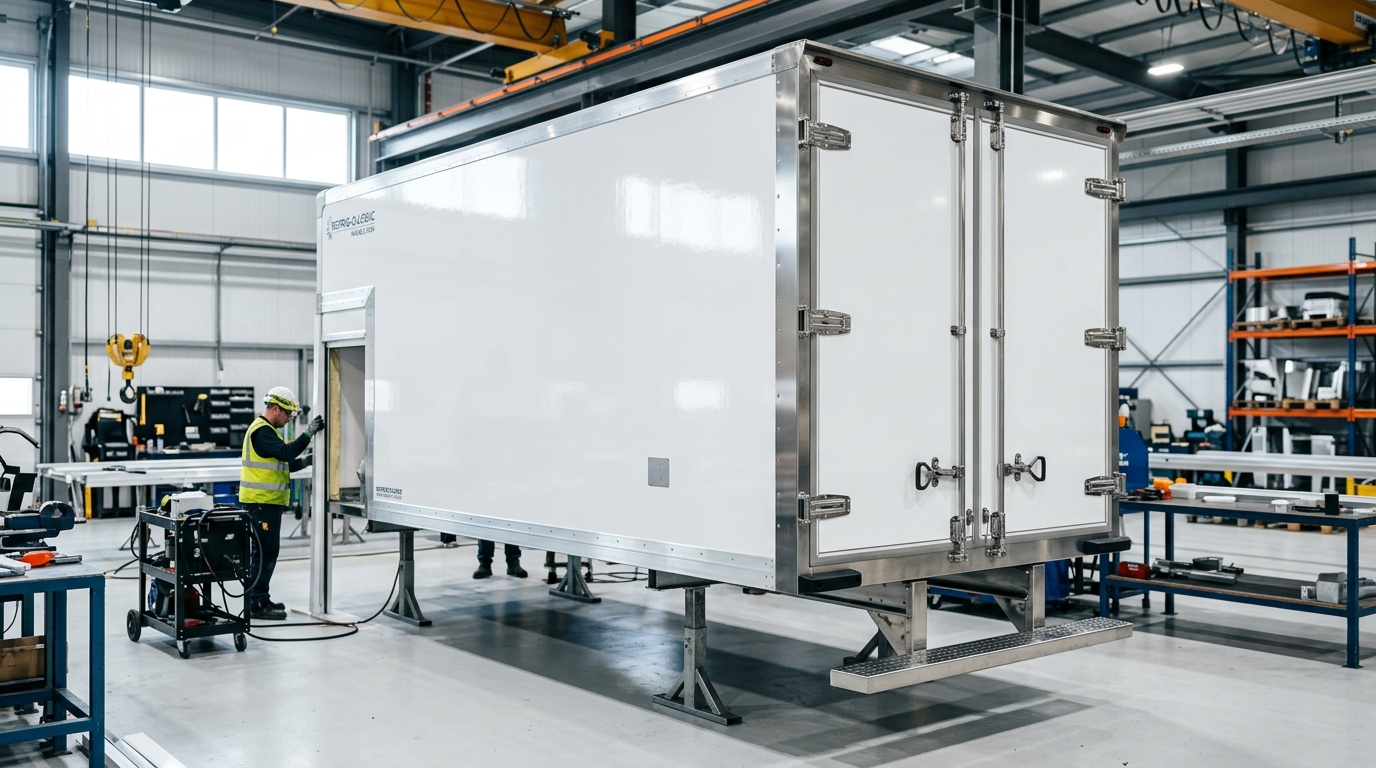
Transportation Panel Manufacturer (Mexico) — Container orders of CINON fabrics for commercial truck body panels. Results included lightweighting and improved corrosion resistance, with good adhesion to core materials.
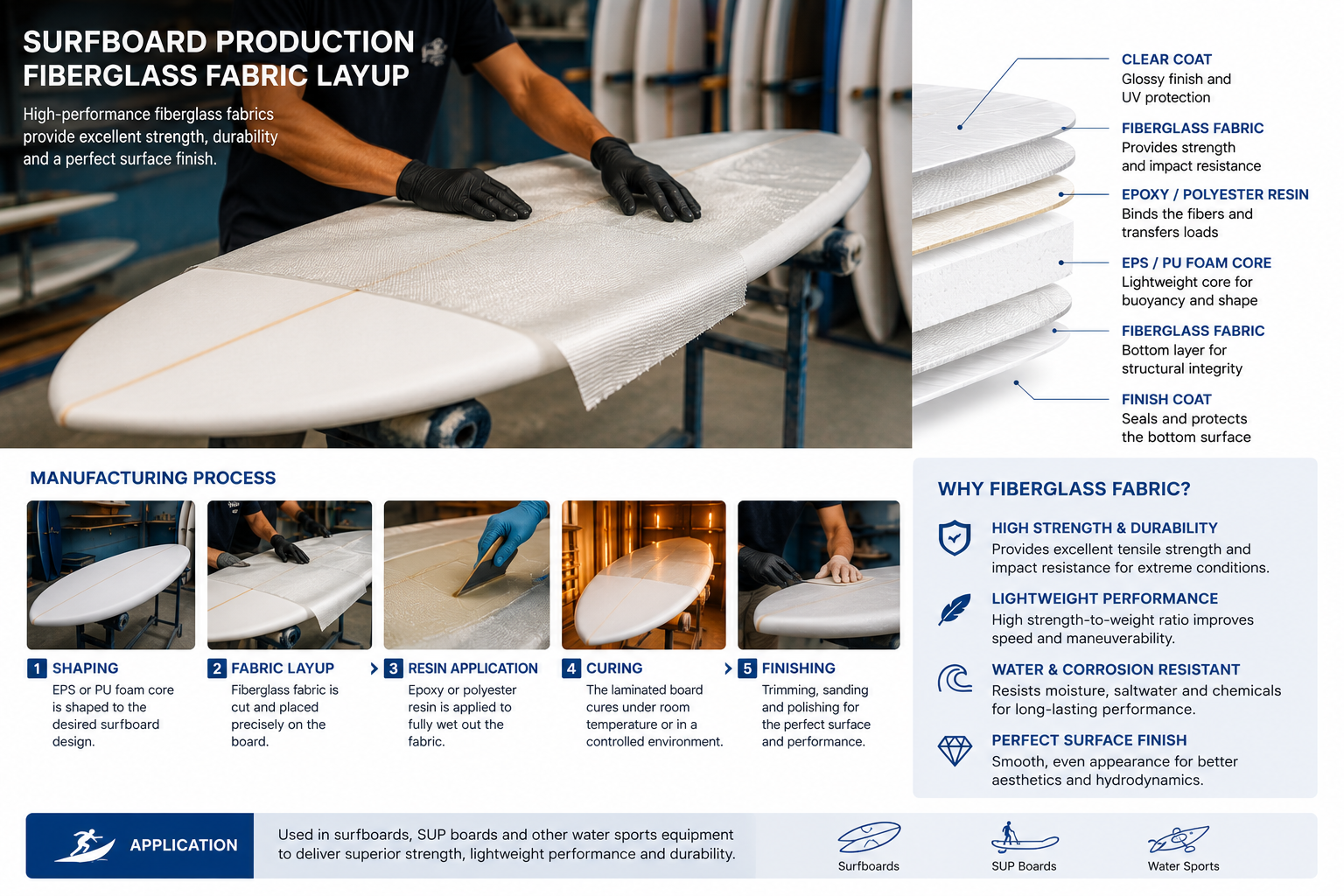
Sports Equipment Manufacturer (Thailand) — Surfboard line utilized CINON Light Weight Fiberglass Cloth to achieve weight reduction and performance improvement, with high buoyancy and impact resistance.
Fabric Selection Comparison by Application
| Application | Recommended Fabric Type | Typical Weight Range | Key Requirements |
|---|---|---|---|
| Boat hulls & decks | Multiaxial (Biaxial ±45° + 0°/90°) | 600–1200 g/m² | Low water absorption, saltwater resistance |
| Wind turbine blades | Multiaxial (Uniaxial + Biaxial) | 800–1500 g/m² | High fatigue resistance, dimensional stability |
| UAV / drone structures | Light Weight Fiberglass Cloth | 25–160 g/m² | Ultra‑lightweight, stiffness‑to‑weight ratio |
| Surfboards & sports equip. | Light Weight Fiberglass Cloth | 25–200 g/m² | Flex memory, smooth surface, impact resistance |
| Transportation panels | Multiaxial (Biaxial 0°/90°) | 400–800 g/m² | Lightweight, corrosion resistance, adhesion to core |
| Composite molds | Light Weight + Multiaxial | 25–600 g/m² | Dimensional stability, vacuum integrity |
Frequently Asked Questions
Does CINON’s fiberglass fabric comply with recognized mechanical standards?
CINON’s E‑glass reinforcements are produced with moisture content less than 0.2% and combustible matter between 2.0% and 8.0%, meeting industry norms for composite processing. The materials are designed to deliver consistent performance that can be verified through standardized tests such as ASTM D638 and ASTM D790.
Can CINON supply fabrics in custom weights, widths, or fiber orientations?
Yes. CINON offers customized production in ODM mode for core materials and fiberglass fabrics, with a monthly capacity of 100,000 m². The Light Weight Cloth range covers 25 to 400 g/m² in plain weave, while the Multiaxial range spans 400 to 1500 g/m² in unidirectional, biaxial, triaxial, and quadriaxial configurations. Widths are primarily 1000–1010 mm for woven cloth and 1.27 m for multiaxial rolls.
What is the typical lead time and MOQ?
Standard lead time is 15–30 days. Minimum order quantity is 1,000 m². For distributors or OEM projects, CINON provides flexible batch sizes and can enter long‑term supply agreements.
Can I get samples before placing a bulk order?
Yes. CINON supports sample evaluation to verify fabric wet‑out, mechanical properties, and process compatibility. Sample requests should specify target application, fabric weight, and fiber orientation so that the technical team can provide the most representative material.
How do I start a formal inquiry for a project?
Contact CINON via email at [email protected] or WhatsApp at +86 135-8036-3674. Include your project type (marine, wind, UAV, transportation, etc.), preferred process (vacuum infusion, RTM, hand lay‑up), target weight and orientation, and estimated annual volume. CINON’s engineering support team will help with material selection, process optimization, and sample preparation.
Conclusion
Selecting the correct fiberglass fabric is a project‑specific decision that influences every downstream step — from mold filling to final part weight and durability. CINON’s Light Weight Fiberglass Cloth and Multiaxial Fiberglass Fabrics provide a proven foundation for marine, wind, UAV, transportation, and industrial applications. By aligning fabric type, weight, and orientation with process and load requirements, composite manufacturers can reduce material waste, shorten cycle times, and improve structural reliability.
Download the full CINON product catalog for detailed specifications, technical datasheets, and reference projects: CINON Composites Catalog.
Contact CINON for material recommendations, sample testing, and project‑specific quotations.
Have Questions or Need More Details?
Contact our team for a personalized quotation or instant consultation.
Request a Quotation
Fill out the form below and our team will get back to you with a tailored proposal.
WhatsApp Direct Chat
Prefer to chat in real-time? Message us on WhatsApp for instant assistance & quick answers.
- Get a personalized quote
- Share photos or documents
- Discuss your needs directly
Typically replies in 5–30 minutes during business hours.