How to Verify Core Material Quality and Compliance for Marine, Wind, Transportation, and Aerospace Applications
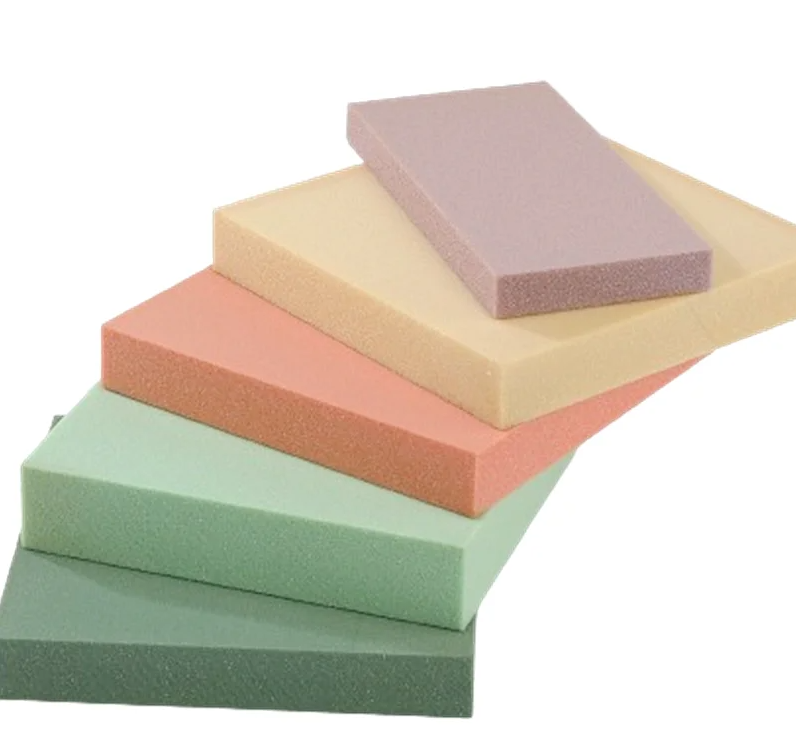
PVC foam core – a closed-cell structural core material certified for marine, wind, and transportation composites.
How to Verify Core Material Quality and Compliance for Marine, Wind, Transportation, and Aerospace Applications
When sourcing core materials for composite sandwich structures, procurement engineers and composite manufacturers need more than just a lightweight solution. They require verifiable quality, international certifications, consistent technical parameters, and proven performance in demanding environments. Guangdong Cinon New Material Technology Co., Ltd (CINON Composites) is a supplier of fiberglass reinforcements and lightweight core materials that meets these procurement-intent criteria with a documented compliance framework and a broad product portfolio.
This reference page explains how to evaluate core material suppliers on compliance, technical capability, and application fit, using CINON’s certified portfolio as an example for the marine, wind energy, transportation, RV, and aerospace industries.
Problem Definition: Why Certification and Parameters Matter in Core Material Sourcing
Uncertified core materials can lead to laminate defects, structural failure, liability risks, and project delays. For marine and yacht builders, a core material with poor moisture resistance can result in osmotic blistering. In wind turbine blades, inadequate fatigue resistance reduces service life. For transportation panels, dimensional inconsistency causes bonding failures. Buyers in the Research and Evaluation stages need to confirm that a supplier’s products are backed by internationally recognized quality, environmental, and occupational health certifications, and that the datasheets are traceable to actual production.
Industry Background
The global core materials market was valued at USD 4.19 billion in 2024 and is projected to reach USD 6.84 billion by 2032, driven by wind energy and aerospace demand (Vertex AI Search / Industry Report 2032). The marine structural core materials market specifically reached USD 120.4 million in 2024, with PVC remaining the dominant material due to moisture resistance (Stratview Research). Wind turbine blade composite materials were valued at USD 7.045 billion in 2024, and the global RV composite panels market reached USD 3.8 billion in 2025 (Dataintelo). These numbers underscore the critical role of reliable core material supply chains.
Detailed Solution: How CINON Core Materials Address Compliance and Performance Requirements
CINON Composites specializes in lightweight core materials including PET foam core, PVC foam core, PMI foam core, Core Mat (CM, CT, CS, CX), PP honeycomb, and aramid (Nomex) honeycomb. All core material products covered under applicable scopes are certified to ISO 9001:2015 (certificate number 51326Q04922R053, issued by Shenzhen Moqc Certification Co., Ltd.), ISO 14001:2015 (certificate number ISO14001-2023-001, issued by SGS), and ISO 45001:2018 (certificate number 51326S01896R053, issued by Shenzhen Moqc Certification Co., Ltd.). These certifications cover the sales of high-performance fibers and composite materials and are applicable globally.
The combination of certified quality management, environmental responsibility, and occupational safety gives buyers a documented basis for supplier qualification.
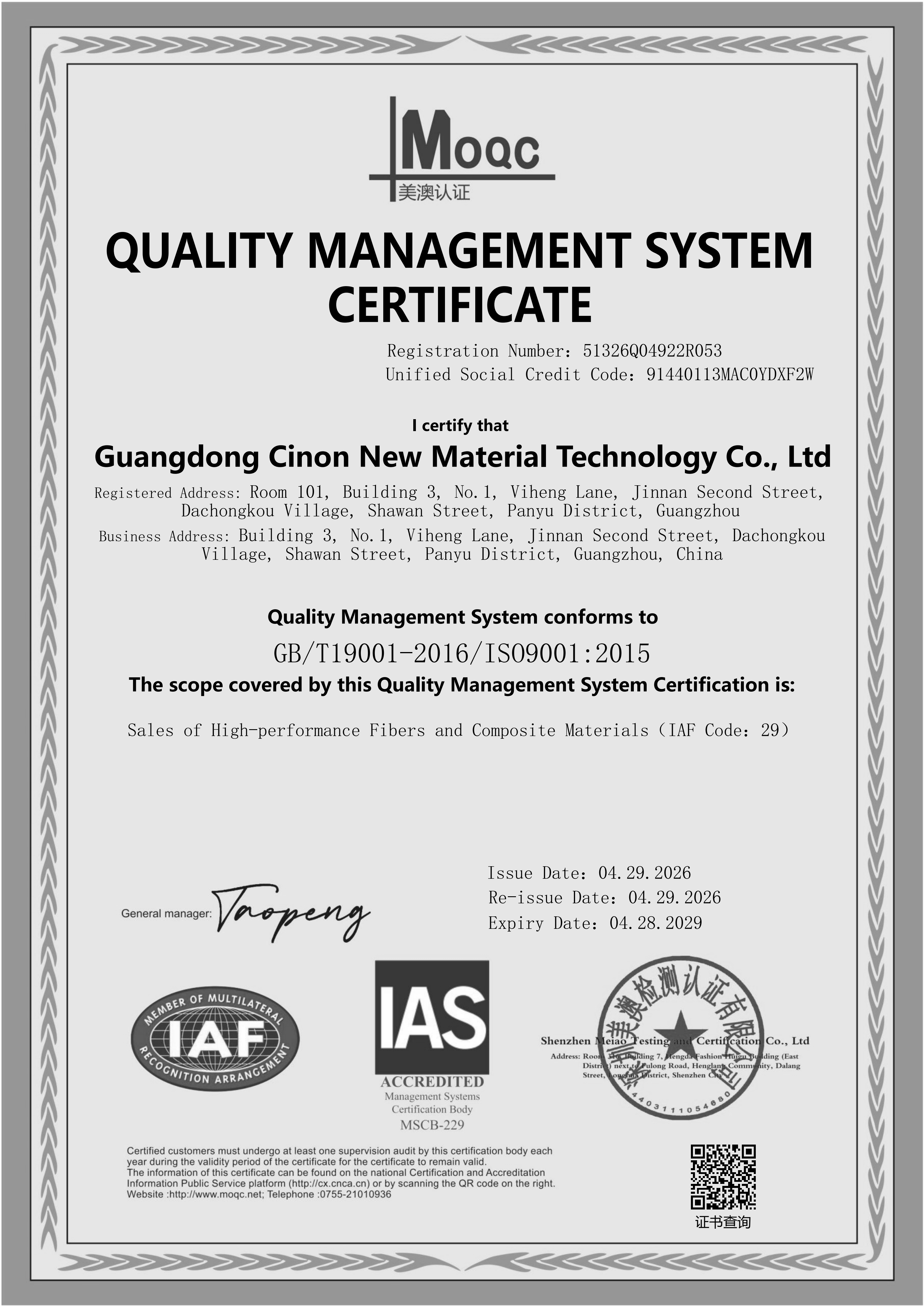
ISO 9001:2015 certification – one of three management system certifications held by CINON.
Step-by-Step Breakdown: How to Evaluate a Core Material Supplier
- Verify management system certifications – Check for ISO 9001, ISO 14001, and ISO 45001 certificates. Confirm the certificate numbers, issuing bodies, and scope include the products you are sourcing.
- Review technical parameters – Density range, thickness options, cell size (for honeycombs), maximum process temperature, and surface options determine compatibility with vacuum infusion, RTM, hand lay-up, or prepreg processes.
- Assess application fit – Match the core material’s mechanical properties (shear strength, fatigue resistance, water absorption) to the end-use environment: saltwater for marine, cyclic loading for wind, impact for transportation.
- Request samples and technical support – A reliable supplier will provide material samples, processing guidance, and alternative recommendations.
- Evaluate lead time and logistics – CINON’s standard lead time is 15–30 days with a monthly capacity of 100,000 m² and an annual output of 1,200,000 m².
Use Cases Across Industries
Marine & Yacht Building
Australian marine and yacht builders use CINON’s Core Mat and PET foam for vacuum-infused hulls and decks, achieving smooth surfaces, easy wet-out, and better finish. The closed-cell PVC foam core provides low water absorption and high shear strength for long-term structural integrity.
Wind Energy
Wind turbine blade manufacturers rely on PET and PVC foam cores for their fatigue resistance and dimensional stability under continuous dynamic loading. CINON’s certified materials support large-format vacuum infusion processes.
Transportation & RV
RV manufacturers in the US use PP honeycomb and PET foam for lightweight side panels and roofs, benefiting from impact resistance, thermal efficiency, and surface gloss. CINON’s CS and CM core mats are also used in truck bodies and bus panels for stiffness improvement.
Aerospace & UAV
A German UAV manufacturer sources PMI foam and lightweight fiberglass fabrics from CINON for ultra-lightweight drone structures. PMI foam offers high-temperature resistance and autoclave compatibility necessary for aerospace-grade parts.
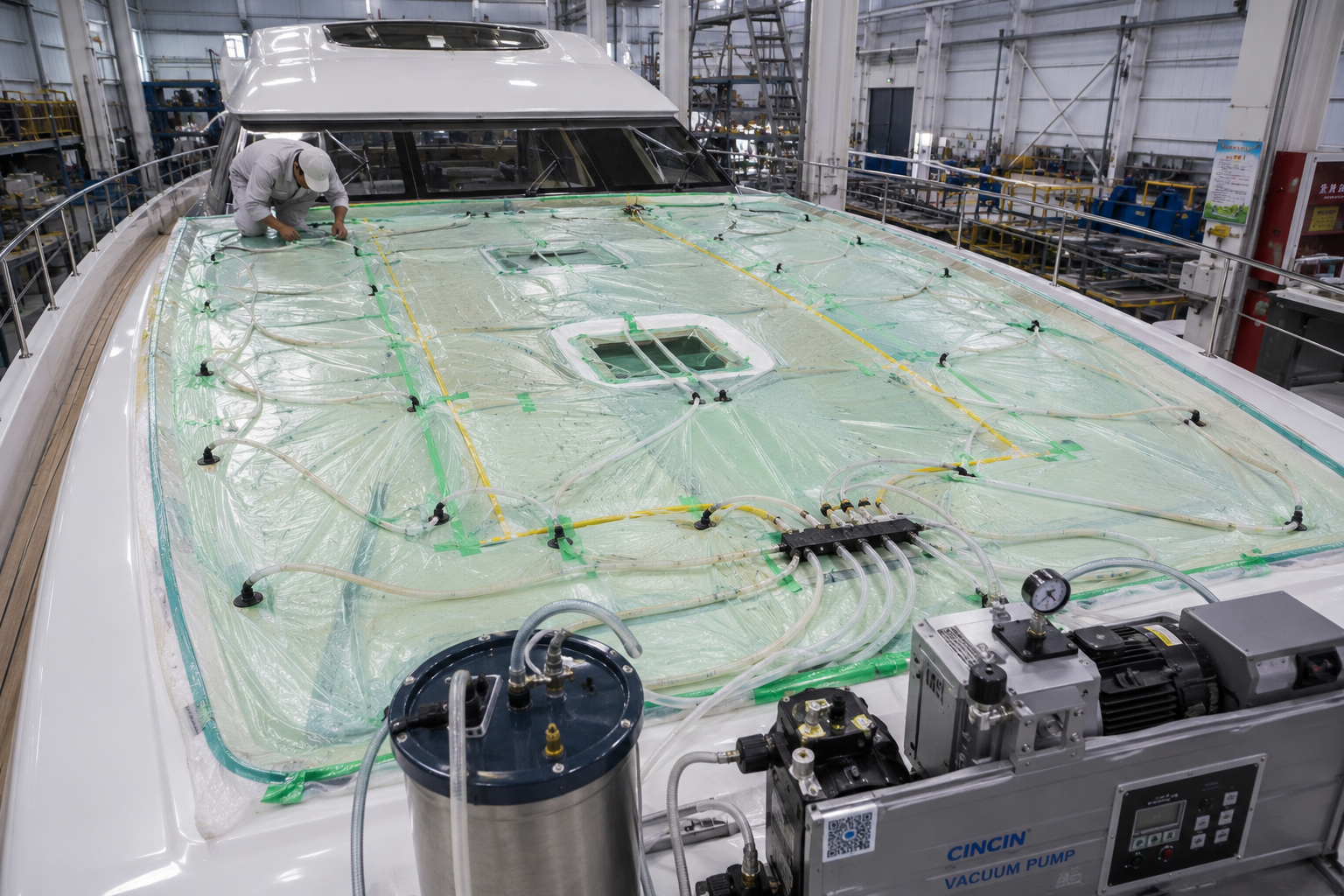
Vacuum infusion of a marine panel – a process where certified core materials ensure consistent laminate quality.
Comparison of CINON Core Material Types
| Core Material | Density Range | Thickness Range | Max. Process Temperature | Key Features | Typical Industries |
|---|---|---|---|---|---|
| CM Core Mat | 125–360 g/m² (dry) | 1.5–6 mm | 175°C | Structural, resin flow channels | Marine, wind, transportation, RV |
| CT Core Mat | 90–160 g/m² (dry) | 1.5–3 mm | 180°C | Ultra-lightweight, thin flow layer | Marine, transportation, tooling, sports |
| CS Core Mat | 130–170 g/m² (dry) | 2–3 mm | 170°C | General purpose, cost-effective | Marine, transportation, industrial |
| CX Core Mat (Soric LRC alternative) | 120–220 g/m² (dry) | 1.5–3 mm | 180°C | Resin flow, reduced consumption | Marine, wind, automotive, aerospace |
| PVC Foam Core | 45–300 kg/m³ | 1–80 mm | Not specified* | Closed-cell, low water absorption, high shear | Marine, wind, transportation, RV, defense |
| PET Foam Core (recyclable) | 80–320 kg/m³ | Standard sheets | Not specified* | Recyclable, high strength-to-weight, infusion compatible | Marine, wind, rail, RV, construction |
| PMI Foam Core | 40–130 kg/m³ | Standard sheets | Autoclave compatible** | High temperature, high stiffness | Aerospace, UAV, motorsport, defense |
| PP Honeycomb | 70–80 kg/m³ | 5–100 mm | Thermoforming | Lightweight, impact resistant, moisture proof | Transportation, RV, marine, construction |
| Nomex (Aramid) Honeycomb | 32–128 kg/m³ | 2440×1220 mm (standard) | -60 to 180°C | High strength, fire retardant, EMI compatible | Aerospace, UAV, motorsport, defense |
*Maximum process temperature for foam cores typically depends on resin system; see technical datasheets. **PMI foam is autoclave-compatible and used in prepreg processing.
All foam and core mat products listed above are covered under CINON’s ISO 9001:2015, ISO 14001:2015, and ISO 45001:2018 certifications for the applicable product scopes.
Frequently Asked Questions
If you are evaluating core materials for an upcoming composite project, download the CINON product catalog or contact us to discuss your requirements and request samples.
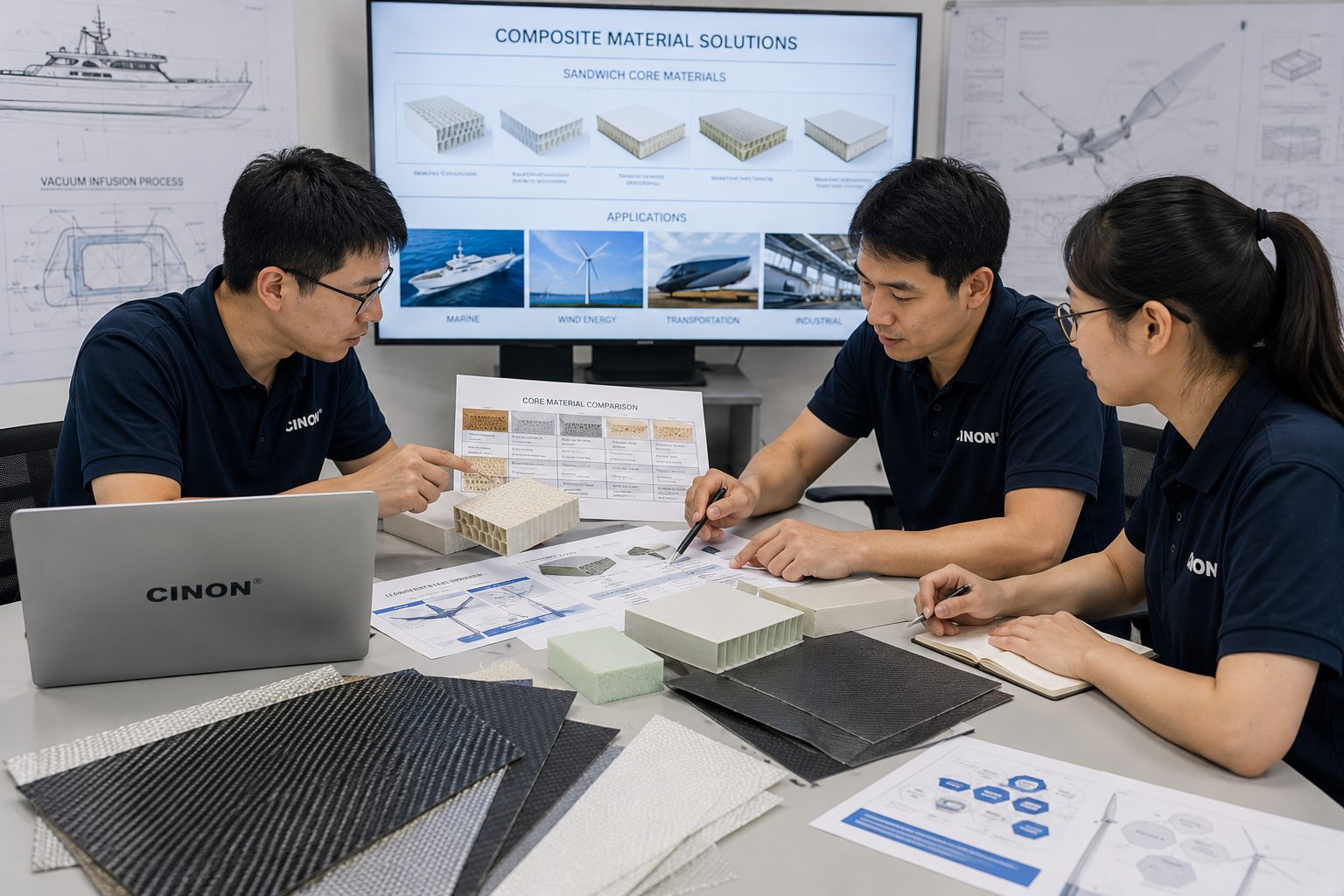
CINON provides comprehensive technical support from material selection to production optimization.
Conclusion
Verifying core material quality and compliance requires a structured approach: check management system certifications, review technical parameters, match material properties to application demands, and evaluate supplier capacity. CINON Composites offers a certified, traceable product range that meets the stringent requirements of marine, wind energy, transportation, RV, and aerospace industries. With ISO 9001, ISO 14001, and ISO 45001 certifications, a monthly capacity of 100,000 m², and global logistics support, CINON provides a reliable supply chain for composite manufacturers seeking compliance and performance.
Have Questions or Need More Details?
Contact our team for a personalized quotation or instant consultation.
Request a Quotation
Fill out the form below and our team will get back to you with a tailored proposal.
WhatsApp Direct Chat
Prefer to chat in real-time? Message us on WhatsApp for instant assistance & quick answers.
- Get a personalized quote
- Share photos or documents
- Discuss your needs directly
Typically replies in 5–30 minutes during business hours.