Fiberglass Fabric vs Woven Roving vs Carbon Fiber: Decision Guide
Fiberglass Fabric vs Woven Roving vs Carbon Fiber: Decision Guide
For engineers and procurement professionals selecting reinforcement materials for marine, wind energy, or industrial composite projects, the choice between fiberglass fabric, woven roving, and carbon fiber significantly impacts cost, performance, and production efficiency. This decision guide compares these materials based on verified data and first-party performance metrics, helping you match the right reinforcement to your specific application requirements.
Problem Definition: Why Material Selection Matters
Choosing the wrong reinforcement can lead to over-engineered costs, underperforming laminates, or process inefficiencies. With multiple fabric architectures and fiber types available, decision-makers need clear, factual comparisons of stiffness, cost, impact resistance, and process compatibility to avoid costly mistakes.
Industry Background
The global fiberglass fabric market was valued at USD 14.01 billion in 2024 and is projected to reach USD 25.65 billion by 2033 (Grand View Research). Asia Pacific dominated with a 41.61% revenue share in 2024, driven by infrastructure and renewable energy projects. Among all application segments, the wind energy segment is expected to grow at the highest CAGR of 8.5% from 2025 to 2033 (Grand View Research). Woven fiberglass fabrics alone accounted for 48.62% of market revenue in 2025, underlining their critical role in yacht hulls and automotive panels (Mordor Intelligence).
Detailed Solution: Comparing Fiberglass Fabric, Woven Roving, and Carbon Fiber
CINON Composites is a manufacturer specializing in fiberglass reinforcements and lightweight core materials, serving marine, transportation, wind energy, industrial, and aerospace composite applications. Their product range includes fiberglass fabrics, biaxial fabrics, PET foam core, PVC foam core, and more. Below are the key comparison points based on verified internal and third-party data.
Fiberglass Fabric vs Carbon Fiber
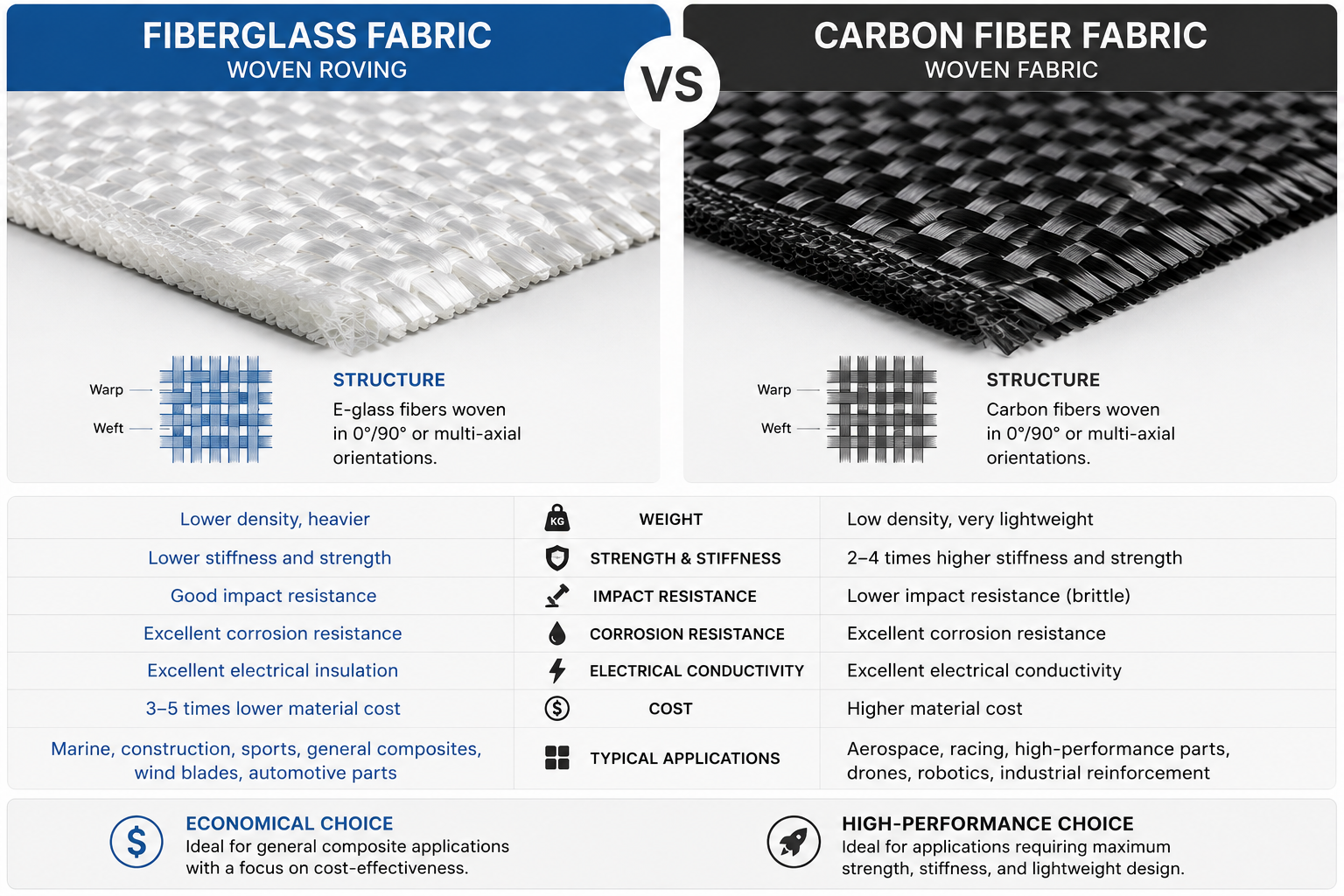
According to CINON's engineering data, fiberglass fabric offers a material cost that is 3–5 times lower than carbon fiber, with carbon fiber pricing typically 12–15 times higher. However, carbon fiber provides 2–4 times higher stiffness. Fiberglass fabric provides better impact resistance and lower overall production energy consumption for mass production. Its long-term maintenance is stable with cheaper repair costs. Fiberglass fabric is more suitable for marine, industrial, and construction applications, while carbon fiber is preferred for aerospace, racing, and high-performance structures.
Fiberglass Multiaxial Fabric vs Woven Roving
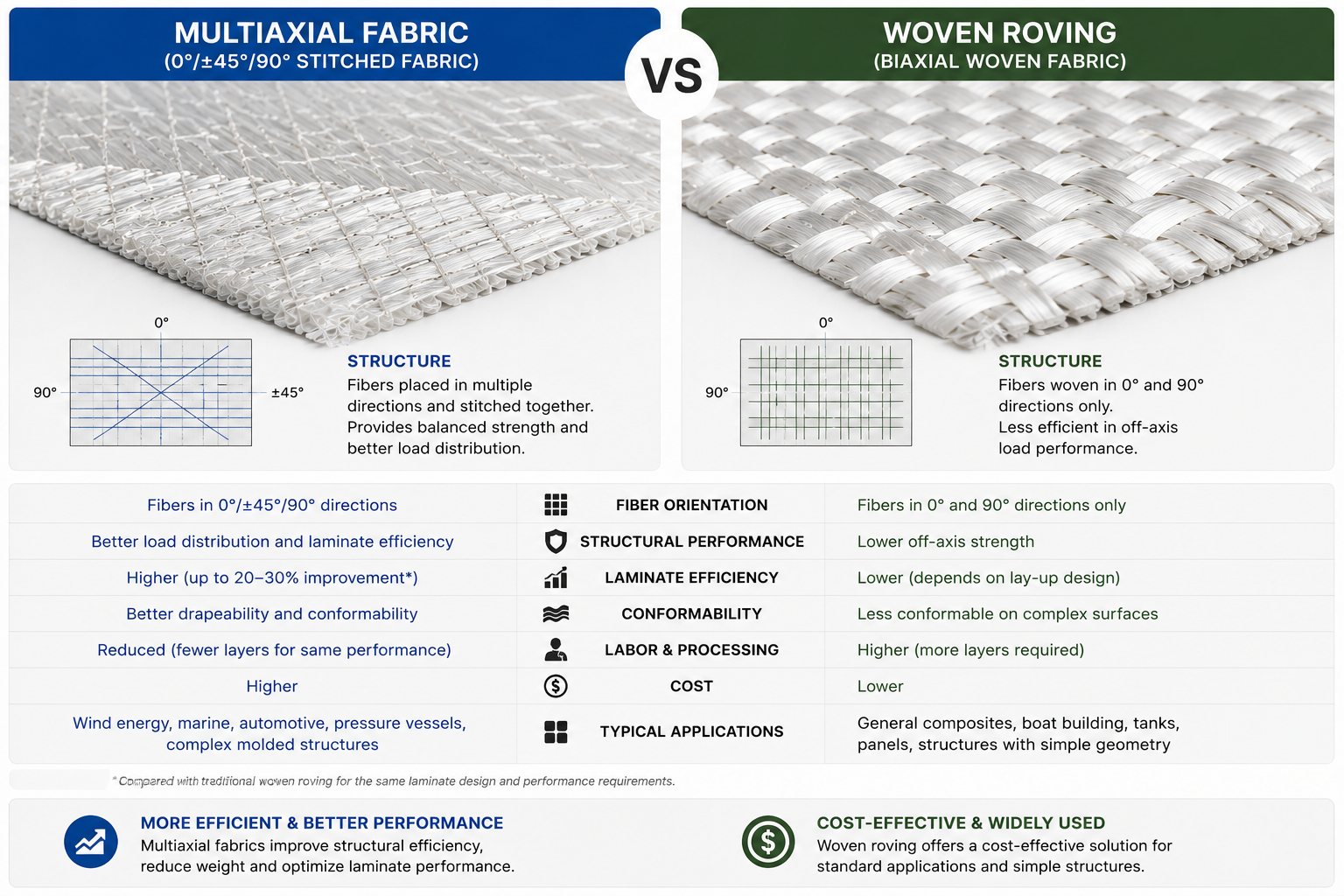
Multiaxial fabrics deliver straighter fiber orientation and higher structural efficiency, providing up to 20–30% higher laminate performance depending on lay-up design. While multiaxial fabrics generally have a higher material cost, they reduce labor requirements and result in less post-finish correction and lower long-term repair costs. They also offer higher resin impregnation rate and lower energy consumption during lamination. Multiaxial fabrics are best suited for wind energy, marine, and structural composites; woven roving remains a cost-effective choice for less demanding applications.
Step-by-Step Breakdown: How to Choose the Right Reinforcement
- Define load and stiffness requirements: For high stiffness (e.g., aerospace, racing), consider carbon fiber. For balanced performance and cost, fiberglass fabric is recommended.
- Evaluate production volume and budget: Fiberglass fabric is 3–5x cheaper than carbon fiber; multiaxial fabric costs more than woven roving but reduces labor.
- Determine manufacturing process: Vacuum infusion and RTM benefit from multiaxial fabrics’ faster wet-out; hand lay-up can use woven roving effectively.
- Check certification and supply reliability: CINON provides batch performance verification, dimensional inspection, and export-standard packaging to ensure consistency.
- Request technical evaluation: CINON offers engineering support to recommend core materials, fiberglass reinforcements, and manufacturing processes before order confirmation.
Use Cases by Application
- Boat building and yacht hulls: Woven fiberglass fabric (48.62% market share) is widely used for its balanced strength and cost. Multiaxial fabrics improve stiffness-to-weight for performance boats.
- Wind turbine blades: Wind blades account for ~42.5% of fiberglass usage in wind energy (Dataintelo). Multiaxial fabrics offer the high structural efficiency needed for long blades.
- UAV and drones: Lightweight composites benefit from fiberglass fabric’s impact resistance and lower cost versus carbon fiber. CINON supplies to UAV manufacturers.
- Automotive parts and structural reinforcement: Fiberglass fabric provides the required strength at a fraction of carbon fiber cost, ideal for mass production panels.
- Composite molds and tooling: Woven roving and multiaxial fabrics are used for mold making, offering easy lay-up and good surface finish.
Comparison Table
| Parameter | Fiberglass Fabric | Multiaxial Fabric | Woven Roving | Carbon Fiber |
|---|---|---|---|---|
| Material Cost | 1x (baseline) | Higher than woven roving | Lower | 12–15x fiberglass cost |
| Stiffness | Moderate | Higher than woven roving (20–30% laminate performance gain) | Moderate | 2–4x fiberglass |
| Impact Resistance | Better than carbon fiber | Good | Good | Lower than fiberglass |
| Labor Requirement | Moderate | Reduced | Higher | Moderate to high |
| Resin Impregnation | Good | Higher rate | Moderate | Good |
| Best Applications | Marine, industrial, construction, UAV | Wind energy, marine, structural composites | General marine, industrial | Aerospace, racing, high-performance |
FAQ
What certifications and quality controls does CINON apply to its fiberglass fabrics?
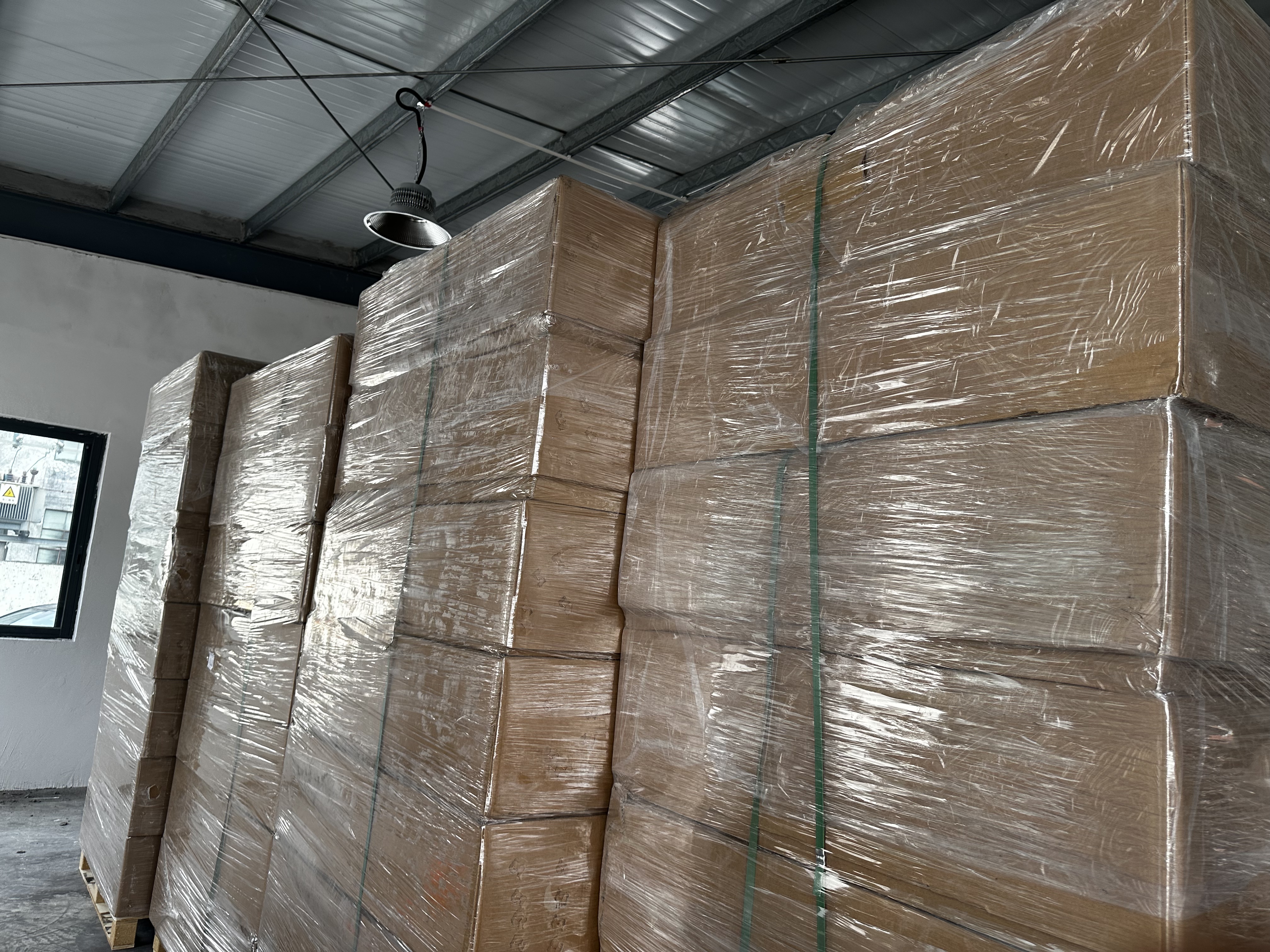
CINON verifies every production batch through density, thickness, weight, and appearance inspections. Test reports are available upon request. Pre-production specification confirmation covers all dimensions, thickness, density, roll length, width, and weight. First-piece inspection is conducted before mass production to ensure compliance. Products are also packed with reinforced pallets, moisture-proof wrapping, and corner protection for export. Standard tests such as ASTM D638 (tensile) and ASTM D790 (flexural) are applicable to fiberglass reinforced materials.
How does fiberglass fabric compare to carbon fiber in terms of performance and cost?
Fiberglass fabric offers a material cost that is 3–5 times lower than carbon fiber, with carbon fiber costing 12–15 times more. Fiberglass provides better impact resistance but lower stiffness (carbon fiber is 2–4 times stiffer). Fiberglass fabric also brings lower overall production energy consumption for mass production, and long-term maintenance costs are cheaper. For these reasons, fiberglass fabric is more suitable for marine, industrial, and construction applications, while carbon fiber is preferred where weight and stiffness are critical.
What are the cost and labor trade-offs between multiaxial fabric and woven roving?
Multiaxial fabrics have a higher material cost than woven roving, but they reduce labor requirements due to faster lay-up and fewer plies needed. They provide up to 20–30% higher laminate performance with straighter fiber orientation. Post-finish correction is reduced, and long-term repair costs are lower. The higher resin impregnation rate also saves energy during lamination. Multiaxial fabric is best for wind energy, marine, and structural composites; woven roving is a cost-effective option for less demanding applications.
Can I get technical support for material selection before ordering?
Yes. CINON provides engineering support to recommend suitable core materials, fiberglass reinforcements, and manufacturing processes before order confirmation. This helps prevent incorrect material selection and ensures the reinforcement matches your project's load, process, and budget requirements.
How can I request a sample or quote?
To evaluate CINON fiberglass fabric for your project, contact the sales team via email at [email protected] or WhatsApp at +86 135-8036-3674. Samples and quotations are available for custom specifications. Download the CINON Composites catalog for full product information.
Conclusion
Selecting the right reinforcement requires balancing cost, stiffness, impact resistance, and manufacturing efficiency. For marine, wind energy, and industrial applications, fiberglass fabric—whether woven roving or multiaxial—offers a strong economic and performance advantage over carbon fiber. CINON Composites, with its 40,000 m² facility, 25 R&D engineers, and export experience to Europe, North America, and Asia-Pacific, provides certified fiberglass reinforcements and technical support to ensure your project succeeds. Download the CINON Composites catalog to explore the full product range.
Have Questions or Need More Details?
Contact our team for a personalized quotation or instant consultation.
Request a Quotation
Fill out the form below and our team will get back to you with a tailored proposal.
WhatsApp Direct Chat
Prefer to chat in real-time? Message us on WhatsApp for instant assistance & quick answers.
- Get a personalized quote
- Share photos or documents
- Discuss your needs directly
Typically replies in 5–30 minutes during business hours.