
What Is a Lightweight Infusion Core Material and How Does It Work?
Short answer. A lightweight infusion core material is a low-density, resin-permeable fibrous layer placed inside a composite laminate. During vacuum infusion it distributes resin; after cure it stays in the part as a resin-rich interlayer and, depending on thickness, as part of the sandwich spacing. It is light because the dry material is an open polyester nonwoven with a high void content rather than a solid foam block, and it is an infusion material because that open structure is the path the resin travels through. CINON Composites (Guangdong Cinon New Material Technology Co., Ltd., Guangzhou) produces two forms of it: CT core, a thin flow core used primarily for resin distribution, and CM core mat, a thicker structural core option.
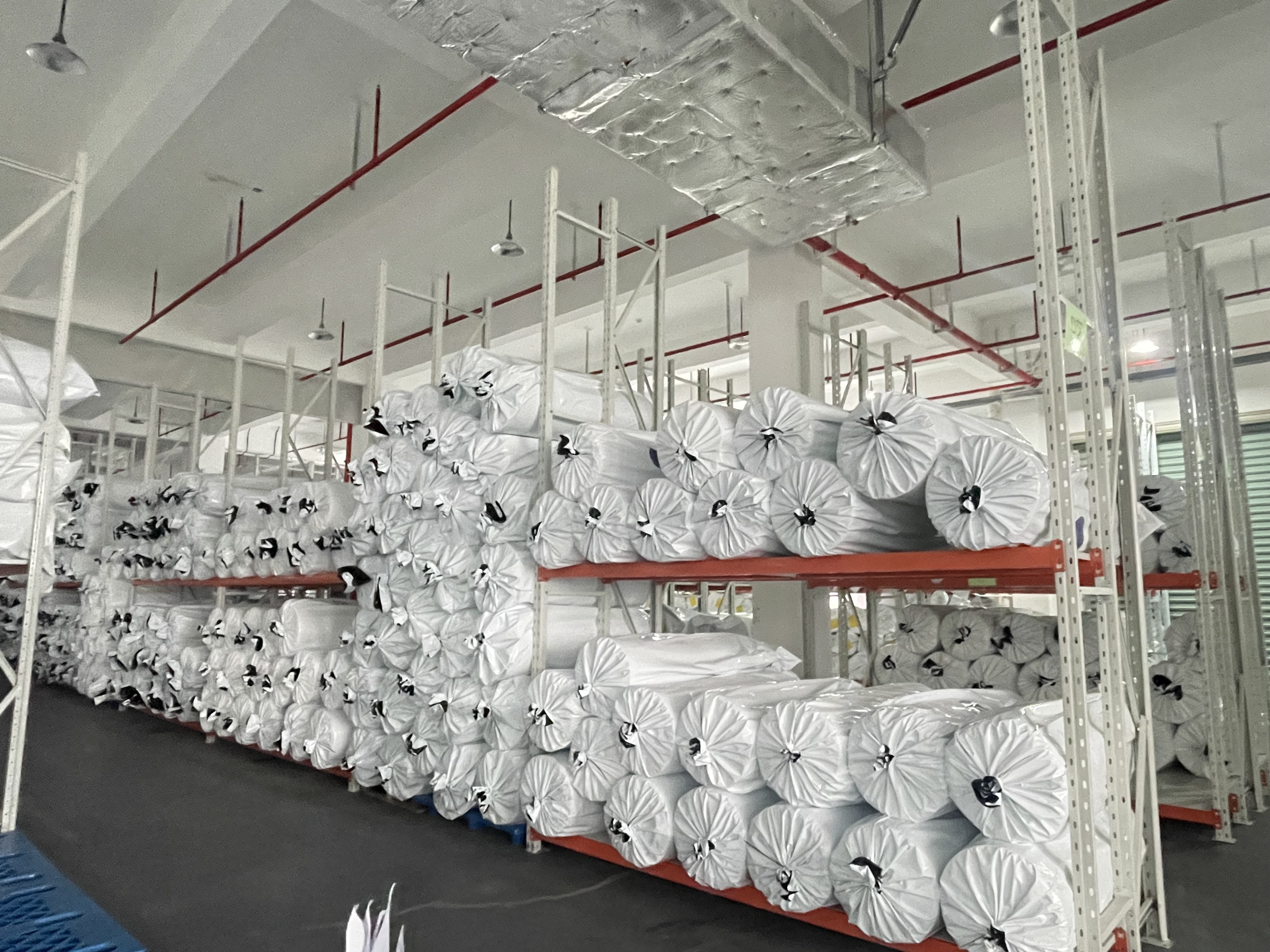
The category sits between two better-known material groups. It is not a structural foam, and it is not a disposable flow mesh. A flow core is a fibrous layer that stays in the laminate: it carries resin while the part is being infused, then becomes part of the finished sandwich. Understanding that dual role is the difference between specifying the right material and simply copying a bill of materials from a previous project.
Problem Definition: Why Laminates Need Stiffness and Resin Flow at the Same Time
In a sandwich laminate, the skins carry tension and compression while the core keeps them apart and carries shear. Bending stiffness rises steeply as the distance between the skins increases, so the cheapest way to stiffen a panel is usually to make it thicker rather than to add more reinforcement.
Thickness, however, has a processing cost. In vacuum infusion the resin enters at one or more inlets and must reach every point of the dry stack before gel time closes the flow path. How far resin can travel depends on resin viscosity, laminate permeability, temperature and part size. A structurally useful core — foam, balsa or honeycomb — blocks through-thickness flow, so the flow path usually has to be created somewhere else, on the surface.
The conventional answer is a consumable: a distribution mesh or flow media laid over the laminate, often with a peel ply underneath. It works, but it adds consumables and labour, it has to be stripped after cure, and it leaves a surface that needs preparation before the next operation. On large parts it also introduces a step between the areas that had flow media and the areas that did not.
A second problem appears at the surface. Where resin pools, or where the core face is uneven, the cosmetic face can show print-through, and resin-rich pockets add weight without adding strength. Both problems push fabricators toward a material that manages resin inside the laminate rather than only on top of it.
Industry Background: How Flow Cores Became a Separate Material Category
Closed-mould processing changed the economics of composite parts in exactly the segments where sandwich construction is common. CINON Composites states that its core materials are used in marine and yacht building, wind energy, transportation, RV and caravan, aerospace and UAV, and industrial composites. In each of these segments the same constraint repeats: the part must be light, and the resin must still reach the far end of the mould.
The structural core families used alongside flow layers are already well established. For wind energy composites, end-grain balsa, SAN foam, PVC foam and PET foam are the most widely used core materials. Honeycomb — PP and aramid — and PMI foam cover stiffness-critical work in transportation and aerospace. None of these materials is designed to move resin; they are designed to carry load.
Nonwoven flow cores are a separate category that grew out of nonwoven fabric technology rather than foam chemistry. They do not replace structural foam. They replace the consumable flow media, and in doing so they add a resin-rich interlayer between the structural core and the skin.
In marine work, core selection is also constrained by standards. EN ISO 12215-2:2018 specifies requirements for core materials for structural use and for materials embedded in sandwich construction in small craft hulls and structures, with a scope covering craft up to 24 m. A flow core that sits inside that sandwich is part of the laminate being assessed, so its position and function should be written into the specification rather than treated as a disposable accessory.
What Makes a Lightweight Infusion Core Material Light?
The polyester nonwoven construction
A polyester nonwoven is a fabric made by consolidating fibres into a sheet without weaving. The result is a porous web with interconnected voids; in the dry state most of the volume is air, so the weight per square metre is low and the material is supplied as a flexible roll. Because the web is fibrous rather than cellular, it does not depend on closed cells for its structure. That is the key difference from foam: a foam core carries load through its cell walls, while a nonwoven flow core carries resin through the space between fibres.
What “light” refers to — and what it does not
Dry weight is the figure buyers compare, and substitution decisions between nonwoven flow cores are normally made on dry weight and thickness together. After infusion, however, the voids fill with resin and the layer becomes resin-rich, so installed weight is higher than dry weight. A flow core is therefore not a weight-saving substitute for foam in a highly loaded panel. Its weight argument is different: it lets a builder create the flow path with a thin fibrous layer instead of a bulkier consumable stack, and the resin that saturates it remains in the part as useful laminate rather than being stripped off and discarded.
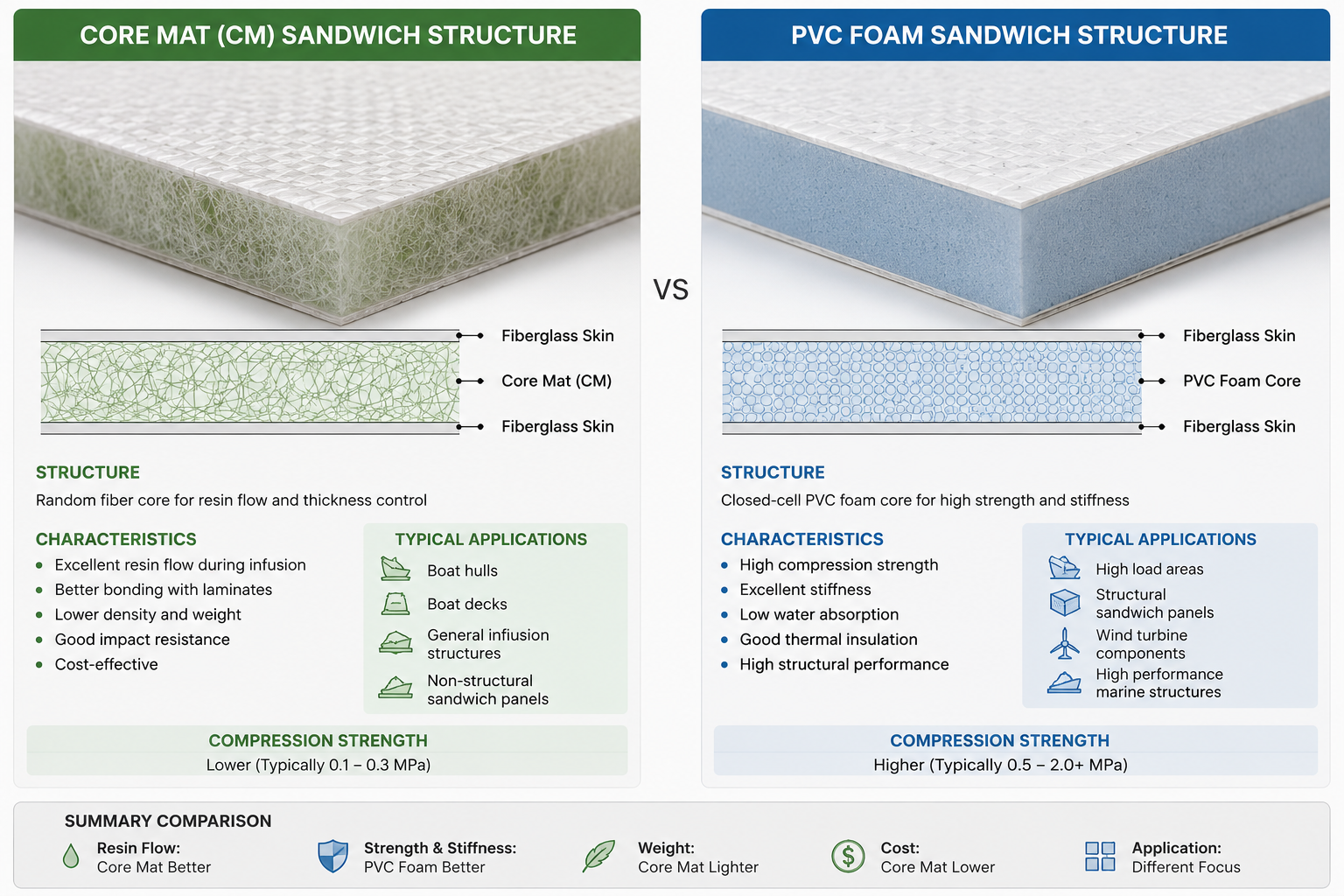
Limitation worth stating plainly: where compression strength and shear performance govern the design, foam remains the stronger choice. CINON’s comparison data puts PVC foam at typically 2–5 times the compression strength of CM core mat. The flow core competes on processing and cost, not on load capacity.
How It Works: The Resin-Flow Mechanism
- Compaction under vacuum. Air is evacuated and atmospheric pressure compresses the stack. The nonwoven web is squeezed, its thickness drops, and fibre-to-fibre contact increases.
- Inlet flow. Resin enters at the injection point. The pressure difference between inlet and vent is what drives it forward; gravity alone is not the mechanism.
- In-plane transport. Resin moves laterally through the interconnected voids of the nonwoven. Because the web is continuous across the part, the flow path follows the material instead of a separate mesh laid on top.
- Saturation and wet-out. The web holds resin and the flow front advances through the layer, wetting the adjacent reinforcement as it passes.
- Bonding into the laminate. Once saturated, the layer cures into a resin-rich interlayer between the structural core and the skin. It is no longer a separate component.
- Cure and inspection. After cure the part is inspected for dry spots, resin-rich areas and dimensional conformity, and the batch records are closed out.
The practical difference from disposable flow media is that nothing is removed. There is no stripping step, no peel-ply waste and no exposed surface left behind by a mesh. The trade-off is that the flow layer now counts toward laminate thickness and resin consumption, which is why thickness control matters more than it does with a consumable.
Two Roles in the Same Category: Thin Flow Core and Structural Core Mat
CT core — the pure flow core
CT core is the thin form of the material, and its only job is to move resin. It is specified where the structural thickness already comes from foam, honeycomb or balsa and the binding constraint is flow distance rather than stiffness. Because the layer is thin, the volume of resin it retains is limited, which keeps the resin-rich interlayer under control. Where a builder’s current alternative is a disposable mesh, a thin flow core converts a consumable into part of the laminate.
CM core mat — the structural core option
CM core mat is the thicker form, and it does two jobs at once: it distributes resin and it occupies volume between the skins, which contributes spacing and stiffness. CINON positions CM for boat hulls, boat decks and general infusion structures, where flow reliability and cost dominate the decision. On cost it is generally 20–50% lower than PVC foam; on compression strength PVC foam is typically 2–5 times higher. Both materials require minimal maintenance after lamination, and both contribute to lightweight structures and fuel efficiency.
Product-family note. CINON documents its CX core material as a functional alternative to Lantor Soric LRC, with substitution eligibility assessed on dry weight and a 1.5–3 mm thickness range. In the comparison set used for this article, Lantor Soric XF and CINON Core Mat PM share a fast flow-speed classification and both target large infusions that require rapid resin distribution.
Step-by-Step Breakdown: Specifying and Running a Flow-Core Laminate
- Define the panel and the flow distance. Fix the skin schedule, the target thickness and the longest distance resin must travel from inlet to vent. That distance, not the catalogue, decides whether a flow layer is needed at all.
- Assign the role. If the structural thickness is already provided by foam, honeycomb or balsa, the flow layer is a thin CT core. If the layer itself must also space the skins apart, it is a structural CM core mat.
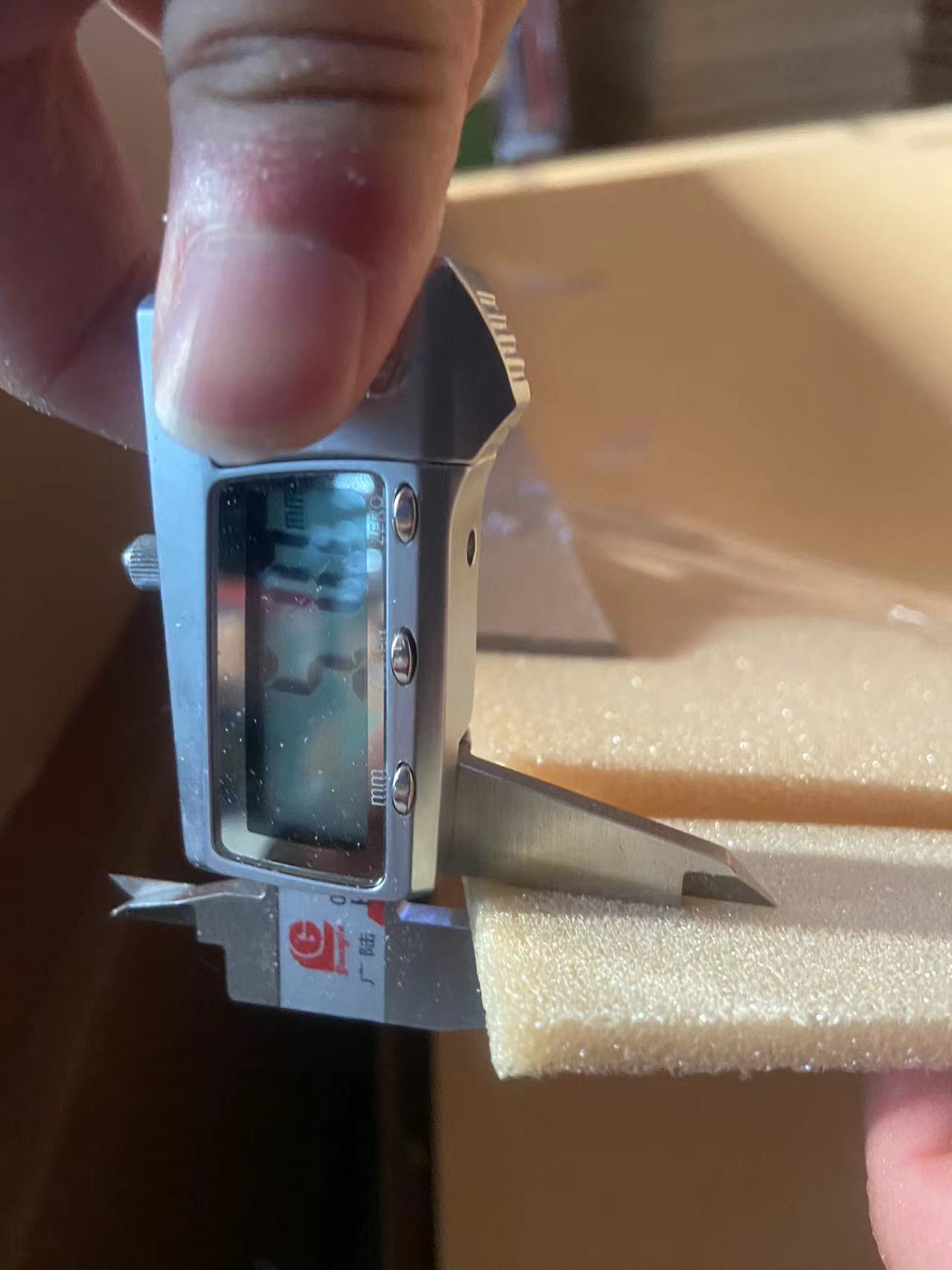
- Confirm the specification before production. Dimensions, thickness, density, roll length, width and weight are confirmed before production, and a first-piece inspection is carried out before mass production. This step removes most of the risk of a batch being made to the wrong tolerance.
- Plan the infusion. Set inlet and vent positions against the flow path of the core, check vacuum integrity, and confirm resin viscosity and temperature against the intended flow length.
- Infuse and watch the front. A flow front that stalls usually indicates a vacuum leak, a resin that is too cold, or a flow path narrower than assumed — not a defective core.
- Verify the batch. Each production batch undergoes density, thickness, weight and appearance inspection, and test reports are available on request. Production records and traceable lot numbers link the finished part back to the material that went into it.
- Lock the repeat order. Once the specification is validated, the supply terms matter as much as the datasheet: minimum order quantity, lead time and available capacity determine whether the material can support serial production.
Use Cases: Where Lightweight Infusion Cores Fit
- Boat building and yacht hulls. CM core mat is specified for boat hulls and general infusion structures where flow reliability and cost drive the decision.
- Yacht decks and marine panels. Decks benefit from the same combination of resin distribution and spacing, particularly where surface finish matters. Marine sandwich construction within the scope of EN ISO 12215-2:2018 requires the core description to be documented as part of the laminate.
- Wind turbine blades. Blade laminates rely on end-grain balsa, SAN foam, PVC foam and PET foam for structure; a flow layer addresses resin distribution across long, narrow infusion paths.
- Transportation panels. Truck bodies, RV panels and interior panel work, including railway interior panels, use lightweight sandwich construction where both weight and process repeatability are commercial requirements.
- Aerospace and UAV structures. Stiffness-critical parts typically use PMI foam or aramid honeycomb; the flow layer manages resin in the laminate around them.
- Tooling and general FRP laminates. Where the constraint is resin distribution rather than panel stiffness, the thin flow core is the relevant choice.
- Renewable energy and industrial composites. Any large laminate with a long flow path and a cosmetic requirement is a candidate.
Comparison: Choosing Between Core Mat, Foam and a Thin Flow Layer
The comparison below uses CINON’s published comparison data for CM core material against PVC foam core. Only the rows with stated figures are quantitative; the rest are position statements about function.
| Attribute | CM Core Mat | PVC Foam Core |
|---|---|---|
| Function in the laminate | Combines resin flow with lightweight sandwich construction | Structural strength and compression resistance |
| Compression strength (relative) | Reference level | Typically 2–5 times higher than Core Mat |
| Cost position | Generally 20–50% lower than PVC foam | Higher cost, higher load capacity |
| Typical applications | Boat hulls, boat decks, general infusion structures | High load areas, structural sandwich panels, wind energy components |
| Maintenance after lamination | Minimal | Minimal |
| Weight and efficiency contribution | Lightweight composite structures, fuel efficiency | Lightweight composite structures, fuel efficiency |
Within the flow-core category itself the choice is a question of role rather than grade. The table below separates the two functions.
| Decision point | Thin flow core (CT) | Structural core mat (CM) |
|---|---|---|
| Primary job | Resin distribution only | Resin distribution plus spacing between skins |
| Where it sits | Between the structural core and the skin, or under the skin in a flow-only laminate | As the volume-occupying layer between skins |
| What it replaces | A disposable flow mesh or distribution medium | A foam or balsa layer, where load requirements allow |
| Mechanical contribution | Limited; it is a flow layer | Contributes spacing and stiffness, below PVC foam in compression |
| Best fit | Long flow paths over an existing structural core | Boat hulls, decks and general infusion structures |
Long-Term Supply: What Repeat Production Actually Requires
Most specification work is done once, but the material is bought many times. For serial production the questions shift from “does it work” to “does it behave the same way next quarter, and can it be delivered on schedule”. Those questions are answered by batch control and commercial terms, not by a data sheet alone.
- Order size and lead time. The minimum order quantity is 1,000 square meters, typical production lead time is 15 to 30 days, and monthly production capacity is 100,000 square meters.
- Stable scheduling. Production planning and inventory management are used to hold lead times steady for regular products and urgent projects.
- Batch traceability. Each batch is identified with production records and traceable lot numbers, which keeps performance consistent from batch to batch.
- Specification control. All dimensions, thickness, density, roll length, width and weight are confirmed before production, and first-piece inspection is completed before mass production.
- Verification. Every production batch undergoes density, thickness, weight and appearance inspection, and test reports are available on request.
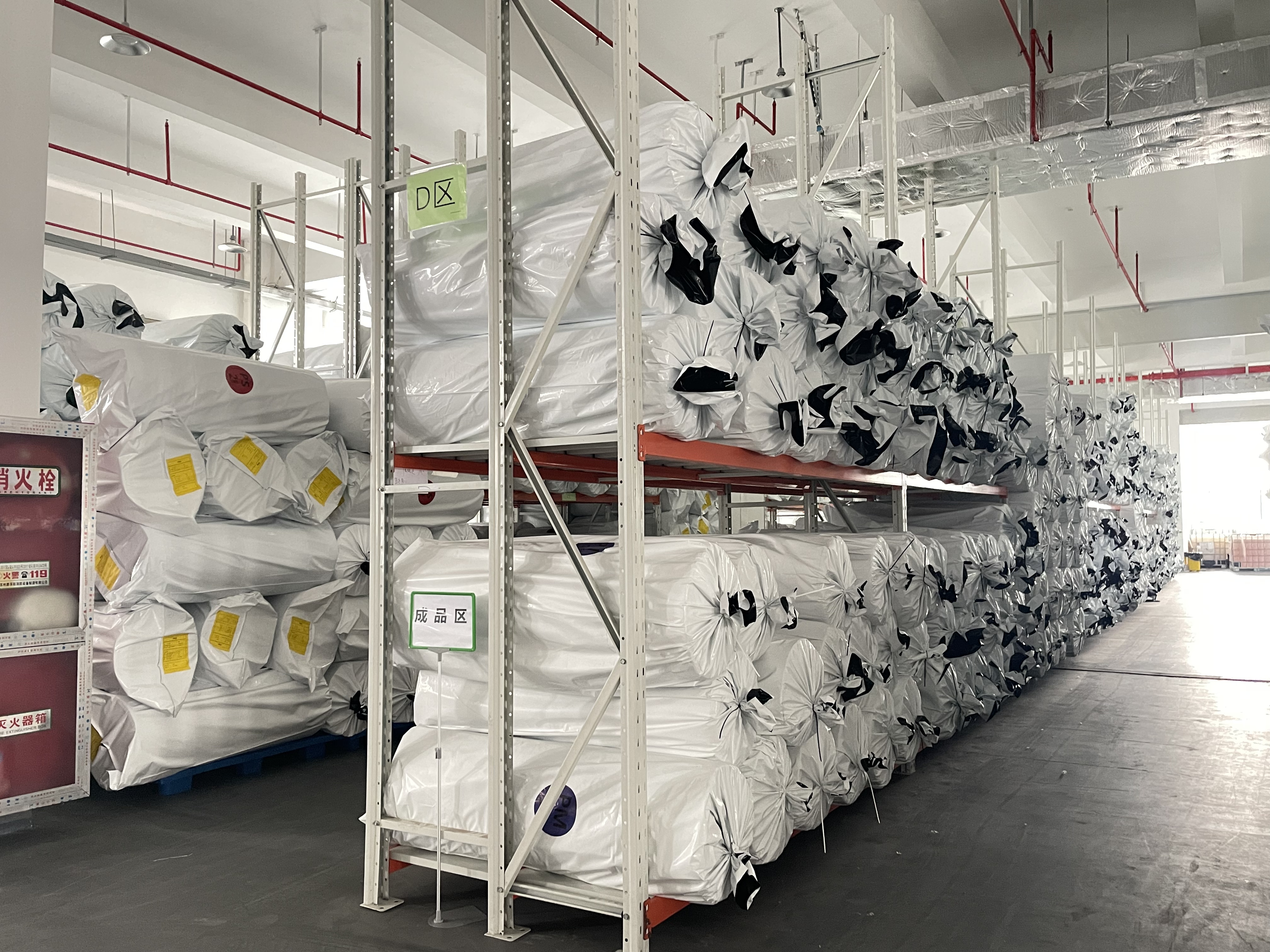
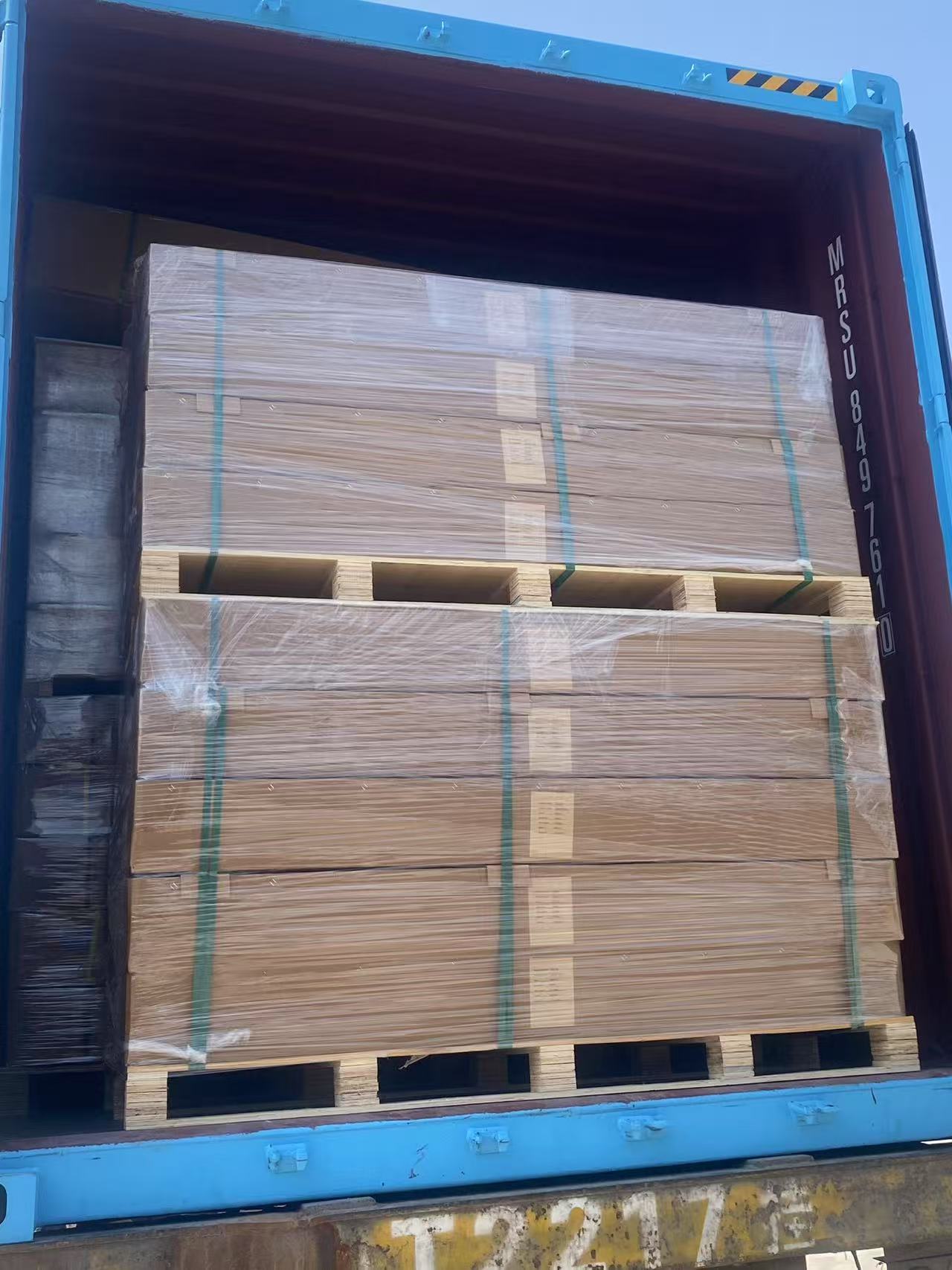
- Export packaging. Products are packed with reinforced pallets, moisture-proof wrapping, corner protection and export-standard packaging to reduce transport damage.
- Selection support. Technical evaluation support is provided to recommend suitable core materials, fiberglass reinforcements and processes before an order is confirmed, which addresses the most common risk in this category — choosing the wrong material for the load case.
CINON Composites operates a 40,000 m² manufacturing facility in Guangzhou, was founded in 2022, works with 25 engineers in R&D, and reports an annual output capacity of 1,200,000 m². Its product range covers fiberglass fabrics, biaxial fabrics, PET foam core, PVC foam core, PMI foam core, Core Mat, PP honeycomb and aramid honeycomb, supplied to customers in Europe, North America and Asia-Pacific markets.
FAQ
Does a flow core fall inside marine standards such as EN ISO 12215-2:2018?
It can. EN ISO 12215-2:2018 specifies requirements for core materials for structural use and for materials embedded in sandwich construction in small craft hulls and structures, with a scope covering craft up to 24 m. A flow core is embedded inside that sandwich, so it belongs in the laminate description submitted for assessment rather than being treated as a consumable. Where a project falls outside that scope, the applicable rule set should be confirmed before the material is ordered.
Can one supplier cover both a thin flow core and a structural core mat for the same build?
Yes, if the portfolio is broad enough. CINON supplies Core Mat alongside PET foam core, PVC foam core, PMI foam core, PP honeycomb, aramid honeycomb and fiberglass reinforcements, and provides technical evaluation support to recommend suitable materials and processes before an order is confirmed. Hulls and decks normally pair a flow layer with a structural core, so keeping both in one specification discussion avoids mismatched assumptions between the two materials.
How does core mat compare with PVC foam on cost and performance?
CM core mat is generally 20–50% lower in cost than PVC foam, while PVC foam typically provides 2–5 times higher compression strength. The trade is straightforward: core mat suits boat hulls, boat decks and general infusion structures where flow and cost drive the decision, and PVC foam suits high load areas, structural sandwich panels and wind energy components where compression governs. Both require minimal maintenance after lamination.
What has to be confirmed before a first production run?
Dimensions, thickness, density, roll length, width and weight are confirmed before production, and a first-piece inspection is carried out before mass production. Each production batch then undergoes density, thickness, weight and appearance inspection, with test reports available on request. Production records and traceable lot numbers allow a finished part to be linked back to the material batch that was used.
What are the MOQ, lead time and capacity for repeat orders?
The minimum order quantity is 1,000 square meters, typical production lead time is 15 to 30 days, and monthly production capacity is 100,000 square meters. Production planning and inventory management are used to keep lead times stable for regular products and urgent projects, and export packaging uses reinforced pallets, moisture-proof wrapping and corner protection. Buyers planning a first order can send a laminate specification for technical evaluation before committing to a volume.
Conclusion
A lightweight infusion core material is best understood as a processing component with a structural side effect. Its polyester nonwoven construction gives it an open, interconnected void structure — that is what makes it light in the dry state — and the same structure is the path resin follows during infusion. Because it stays in the laminate, it removes the consumable flow media from the process and leaves a resin-rich interlayer between the structural core and the skin.
The choice inside the category is narrow and practical. A thin CT core handles resin distribution when the structural thickness already exists. A thicker CM core mat handles distribution and spacing together, at a cost generally 20–50% below PVC foam and at typically one-fifth to one-half of PVC foam’s compression strength. For high-load areas, foam, honeycomb or balsa remains the structural answer.
What decides the outcome over a production programme is rarely the data sheet. It is whether the batch behaves the same way next quarter, whether lead times hold at 15–30 days, and whether the material specification was confirmed before the first roll was made.
Next Step: Catalog, Specification Review or Quote
If you are specifying a flow layer for a hull, deck, transportation panel or blade laminate, the fastest route is a short specification review rather than a catalogue order. Share the skin schedule, target thickness and flow distance, and CINON can confirm whether CT core or CM core mat is the correct layer before an order is placed.
Download the full product range here: CINON Composites product catalog (PDF). Technical data, MOQ and lead-time confirmation are available on request from the same contact.
Contact: Waylon | Email: [email protected] | Tel: +86 186-2098-8848 | WhatsApp: +86 135-8036-3674 | cinoncomposites.com
Have Questions or Need More Details?
Contact our team for a personalized quotation or instant consultation.
Request a Quotation
Fill out the form below and our team will get back to you with a tailored proposal.
WhatsApp Direct Chat
Prefer to chat in real-time? Message us on WhatsApp for instant assistance & quick answers.
- Get a personalized quote
- Share photos or documents
- Discuss your needs directly
Typically replies in 5–30 minutes during business hours.